
27 minutes. This is the average time a French employee spends each day commuting to work. But behind this statistic lies a fragmented reality: nearly one in six workers exceeds 45 minutes of daily travel, with a growing divide between cities served by public transport and rural areas where the car reigns supreme. Commuting habits reshape our days, influence our mood, and sometimes weigh heavily on personal balance. Expectations, local infrastructure, and professional pressure disrupt traditional patterns. Finding the right formula to optimize these commutes becomes a variable challenge.
Understanding the impact of commuting on daily life
Invisible yet omnipresent, the commute shapes our schedules, infiltrates our evenings, and affects the energy we have left to dedicate to our loved ones. Persistent fatigue, irritability, increased mental load: the distance between home and the office rarely leaves one indifferent. The quality of life at work is also defined on the pavement or in transit, well beyond the workstation itself.
In the city, the routine consists of transfers and tight time slots. Elsewhere, the steering wheel becomes essential, generating other troubles. Each commute raises the same question: should one accept spending an hour or more on daily travel? The labor code sets certain benchmarks, but the margin for interpretation remains vast and varies from one department to another, from one company to another.
When the kilometers increase, beware of disengagement: marked absenteeism, insidious fatigue, and sometimes a vicious cycle of demotivation that slowly erodes daily life. It’s no surprise that work reorganization, telecommuting days, or flexible hours are becoming more common. Recent trends and precise figures are detailed here: read on J’entreprends Au Féminin.
Behind national averages, the disparities are striking: 27 minutes is just a statistic. Between city, countryside, industry sector, and personal desires, everyone invents their own rules to cope with the reality on the ground.
What is the ideal distance for commuting to work? Statistics, limits, and realities
Defining the “ideal” commute distance is a balancing act. According to Insee, an average commute measures 15 kilometers. But geography reshuffles the cards: in Île-de-France, the length of the commute gives way to the headache of time spent in traffic jams or on the RER. In the countryside, the kilometers increase, but paradoxically, the time is sometimes less fragmented and interruptions less frequent.
To illustrate these nuances by territory, here are some benchmarks:
- In the Paris region and large cities, commutes cover few kilometers but stretch endlessly due to waiting and density.
- In rural areas, employees travel greater distances, often more quickly and without multiple interruptions.
Once the 45-minute mark is crossed, quality of life deteriorates. Many employees report increased fatigue, feelings of isolation, or gradual disengagement. Studies converge: thirty to forty minutes seems to be a ceiling not to be exceeded to maintain balance. Beyond that, fatigue takes hold.
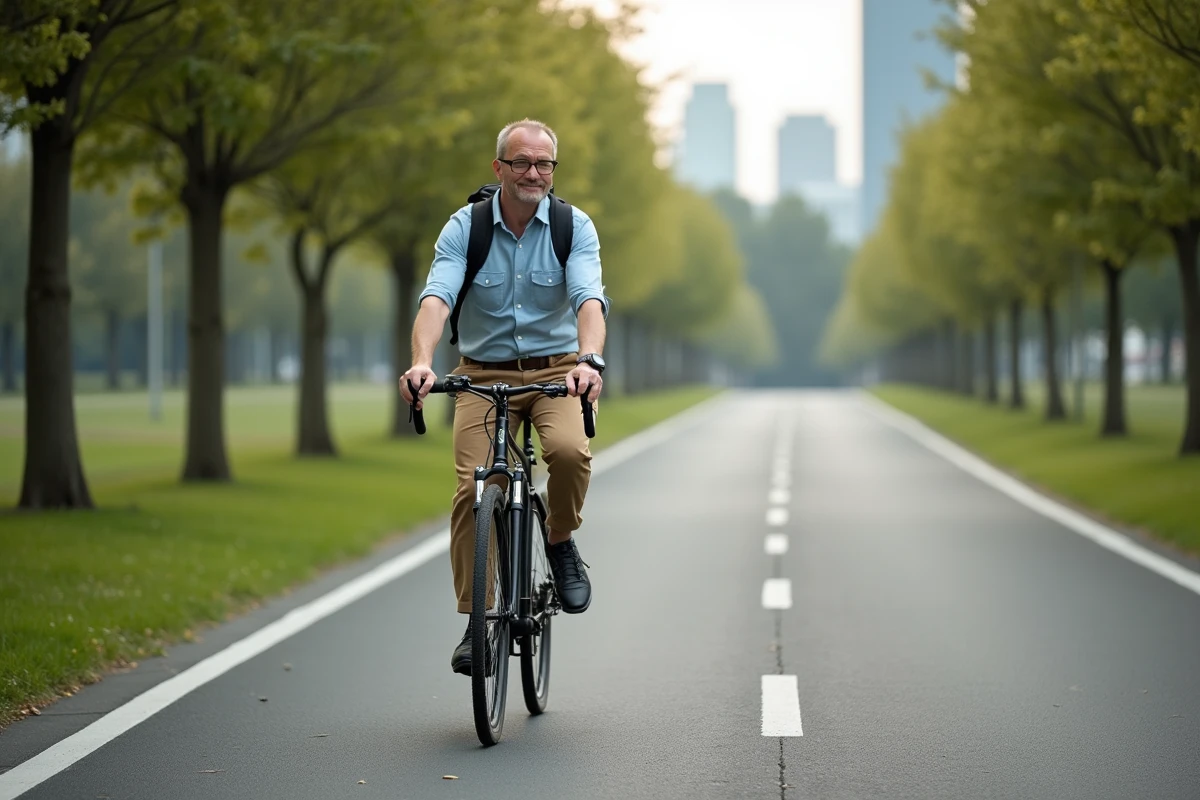
The solution varies by situation: some rely on the car when there are no alternatives, while others prefer biking or walking whenever the urban layout allows. Flexible hours, local transport services, and gentle transitions add to the equation. Choices are made based on resources, constraints, and, above all, the desired lifestyle.
Practical tips for organizing commutes and exploring sustainable alternatives
As commuting takes up an increasing share of our schedules, saving time and reducing environmental impact becomes a priority for many. The choice of transport mode heavily depends on the context: in urban areas, walking or biking are often the most pragmatic and enjoyable options, while in suburban areas, a mix of cars, trains, buses, and shared solutions is advantageous.
Here are some concrete levers to reorganize commutes and improve daily life:
- Adjusting hours to avoid congestion in transport and gain precious minutes.
- Requesting the implementation of telecommuting when the job allows.
- Opting for carpooling on long distances to share costs and break the monotony of daily life.
Metropolises like Strasbourg are leading the way with the proliferation of bike lanes and park-and-ride facilities that facilitate mode changes. The development of hybrid options, from car sharing to electric bikes, profoundly alters our commuting routines.
The Labor Code also supports this evolution: employer contributions to transport costs encourage the abandonment of solo driving. For their part, employees can request the CSE to demand collective solutions that truly streamline professional commuting.
Each route composes a unique score, made up of constraints, opportunities, and sometimes fragile balances. Finding one’s own distance is also about transforming the daily commute into a testing ground. And what if, tomorrow, the path to the office opened the door to a routine finally suited to one’s needs?