
The Palm Tree drinking game is based on a simple principle: a pyramid of face-down cards, accusations between players, and drinks handed out. The basic mechanics combine bluffing and memory, since each player has to remember the cards in their hand to challenge or accept an accusation. The problem arises when the only consequence of a failed turn is having to drink more, reducing the game to a race to consume rather than a true tactical duel.
Replace drinks with a points system in Palm Tree
The most effective way to add strategy to Palm Tree is to replace drinks with points or tokens. Each successful accusation earns the accuser a point, while a caught bluff costs the player who tried it a point. The winner is whoever has the most points at the end of the pyramid.
This shift changes the nature of the decisions. Accusing an opponent on the pyramid’s bottom row earns more, but the risk of losing points also increases if the accusation is successfully challenged. Players familiar with the rules of the Palm Tree drinking game know that the value of the cards increases with each level of the pyramid. Turning those levels into point multipliers preserves the rising tension without making the stakes depend on how much alcohol is consumed.
Drinks can still be part of the fun, but they become optional. Players can choose to have a sip, drink a soda, or take on a mini-challenge instead, without affecting their score. The competition shifts to reading opponents and managing risk.
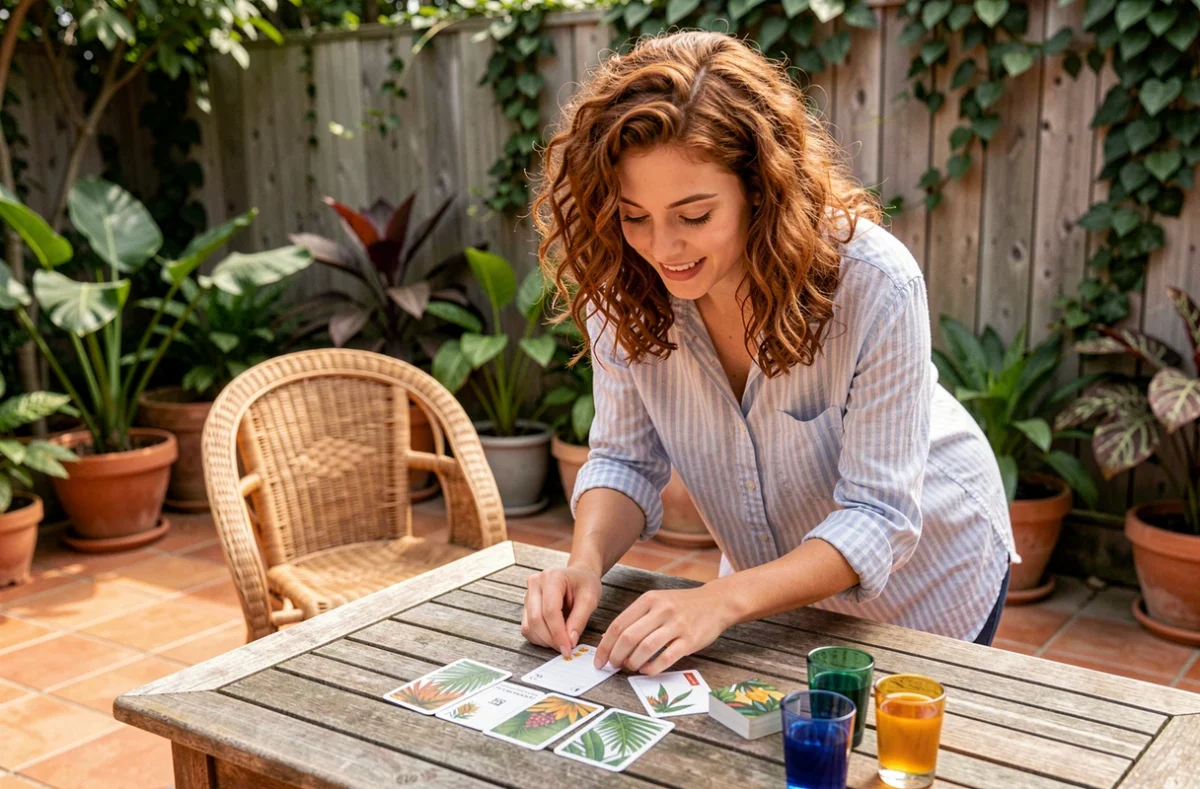
Challenges and memory constraints: special cards in strategic Palm Tree
To keep the game from becoming nothing more than a dry points calculation, certain cards can trigger temporary constraints. The goal isn’t to pile on complicated rules, but to add layers of decision-making that reward attentiveness.
Category challenge cards
When a player turns over a red card on the pyramid, they set a category (capital cities, car brands, first names beginning with a given letter). The first player to fail loses a point. This mechanic borrows from trivia games and forces everyone to stay focused between turns, even when it isn’t their turn to accuse someone.
Temporary rule cards
A black card on a higher level of the pyramid can activate a rule for the next three turns: no saying a common word, answering with a question, or reversing the direction of play. These rules are agreed on before the game and written down on a sheet where everyone can see them.
Agreeing on what the cards mean before the first one is drawn and writing it down helps avoid arguments during the game. Rules agreed on collectively before play are more likely to stick than rules improvised in the heat of the moment.
- Red cards trigger a category challenge (the loser loses a point, while the winner gains none: the penalty is more motivating than the reward).
- Black cards on the bottom two levels activate a temporary constraint chosen from a list prepared by the group.
- Face cards (jack, queen, king) let the accuser double the points at stake, but also triple their loss if they bluff and get caught.
Alcohol-free options and game pace: keep Palm Tree fun for everyone
A game loses its festive feel as soon as a participant feels pressured to drink. The most overlooked way to keep the atmosphere fun is to remove any social penalty for refusing to drink. A player who chooses water, soda, or a physical challenge (push-ups, an impression, a creative forfeit) doesn’t lose any points, and their choice isn’t passed on to another player.
This rule isn’t just a minor organizational detail. It changes the group dynamic: when the pressure is gone, players take bolder risks with their accusations because failure no longer has an unpleasant physical consequence. Bluffing becomes more common, and comebacks more dramatic.
Alternate drinks and slow down without losing momentum
Alternating with a non-alcoholic drink only makes a real difference if it replaces an alcoholic one. Adding a glass of water between two beers without reducing the number of beers doesn’t change the total consumed. What matters is replacing a drink, not adding one.
In practice, setting a personal limit before the evening begins (for example, a maximum number of sips) and turning it into physical tokens works well. Once the tokens run out, the player automatically switches to challenges. The game continues, the score changes, and nobody is left out.

Summary table: classic Palm Tree vs. strategic Palm Tree
| Element | Classic Palm Tree | Strategic Palm Tree |
|---|---|---|
| Consequence of a successful accusation | The accused drinks | The accused loses points (drinking is optional) |
| Failed bluff | The accuser drinks double | The accuser loses double the points |
| Moving up the pyramid | More sips | Higher point multiplier |
| Special cards | Rarely used | Category challenges, temporary rules, doubled stakes |
| Alcohol-free option | Often frowned upon | Included with no score penalty |
Strategic Palm Tree requires no extra equipment beyond a score sheet and a pen. The cards stay the same, as does the pyramid. What changes is the nature of the stakes: the fun comes from the decisions you make, not the glasses you empty. The player who reads their opponents best, manages their accusations, and remembers their cards wins the game, whether their glass contains wine or lemonade.