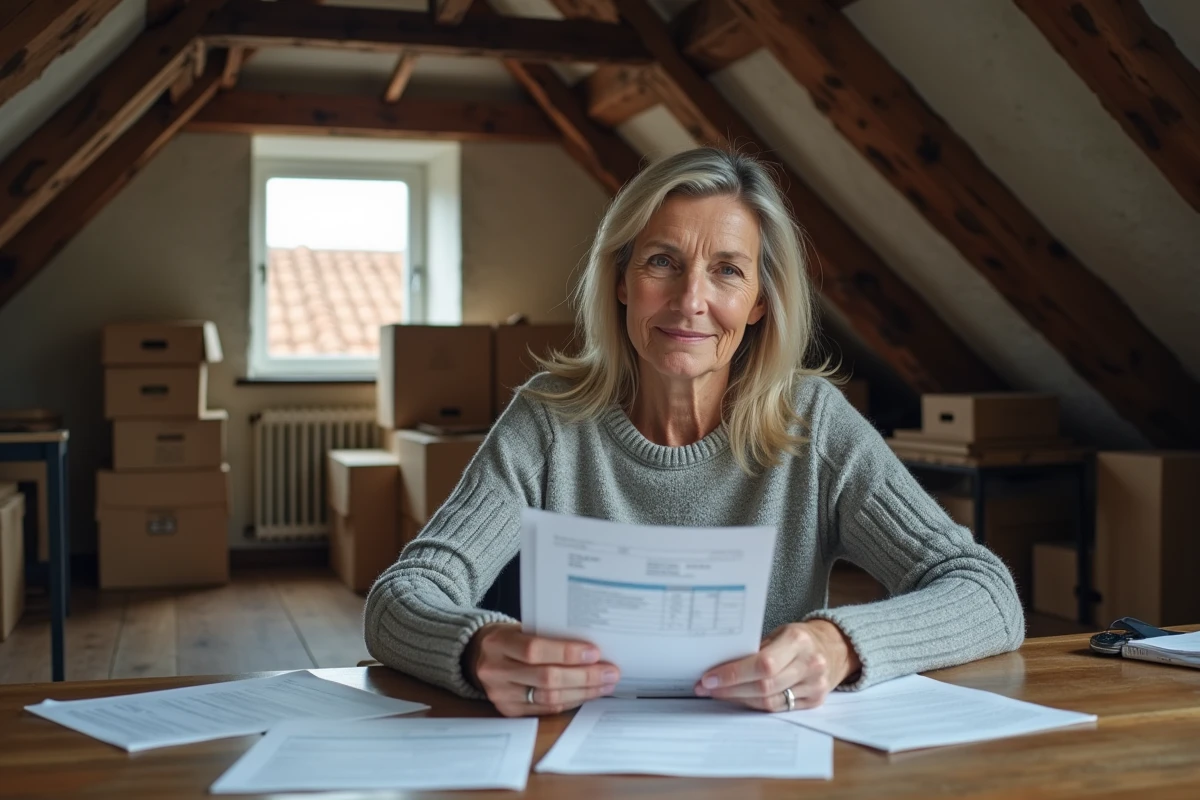
You own a house with an attic under the roof, and your property tax notice seems high. Could the attic, even if unused, be inflating the bill? The answer depends on the actual condition of that space and how it has been declared to the tax authorities. Understanding the calculation of property tax for an attic helps avoid overpayment or the risk of reassessment in case of under-declaration.
Weighted area and cadastral rental value: what the tax authorities really measure
Property tax is not based on the traditional living area. It relies on the cadastral rental value, a theoretical rent that the property could generate if it were rented out. To calculate this value, the administration uses the concept of weighted area.
The weighted area takes into account each room of the dwelling, but applies different coefficients according to their use and comfort. A heated bedroom with a large window will have a higher coefficient than a dark attic without insulation.
In practical terms, an unconverted attic is not counted as a living space. It does not count towards the number of rooms in the property tax sense, which are used to determine the category of the dwelling. However, it still needs to be declared. An unconverted attic is included with a reduced coefficient in the rental value. Therefore, it weighs less than a living room, but it is not invisible to the tax authorities.
Unconverted attic or habitable attic: the distinction that changes property tax
Many articles simply state that an unconverted attic is not taxed. This is a misleading shortcut. The tax administration is increasingly distinguishing between two situations. To better understand these nuances, consult this article on the calculation of property tax for an attic.

The non-developable attic
A space under the eaves without a solid floor, natural light, and practical access (trapdoor or ladder) is considered a minor outbuilding. Its weighting coefficient is very low. It contributes little to the rental value.
The attic with floor, light, and access
As soon as an attic has a load-bearing floor, a skylight or roof window, and a fixed staircase, the administration can reclassify it. Even without complete renovation work, this space can be taxed as an additional room, with a much higher coefficient.
The determining criterion is not the use you make of it, but the potential for habitability recognized by the tax authorities. An attic converted into an office, playroom, or guest room without prior declaration is subject to reassessment.
Declare or correct the area of an attic on impots.gouv.fr
Since the 2023-2024 campaign, the online service “Manage my real estate” on impots.gouv.fr allows you to check and correct the declared areas for each property. This service details room by room what the administration considers for calculating the rental value.
You can find out if your attic is registered as an outbuilding, an annex room, or a main room. If the recorded area is incorrect (for example, an attic counted as a bedroom when it is not converted), a correction request can lower your property tax.
Here are the elements to check before taking any action:
- The declared nature of the space: outbuilding, annex room, or main room. An unconverted attic should not be listed among the main rooms.
- The recorded area: compare it to the actual floor area of your attic. An error of a few square meters can change the calculation.
- The applied coefficient: if your attic without comfort is weighted as a heated room, the rental value is artificially inflated.
The correction involves an online claim, directly through the service. The administration can then send an agent to verify the reality of the space on-site.
Converting an attic: the concrete impact on property tax
Transforming an attic into a habitable room necessarily changes the rental value of the property. Insulation work, the installation of roof windows, the addition of a fixed staircase, or connection to heating shifts the space into the category of habitable areas.

The owner is required to declare this work within 90 days of its completion, via the property declaration form or the online service. Failure to meet this deadline may result in penalties.
In return, some local authorities grant a temporary exemption from property tax for new constructions, including interior extensions like attic conversions. This exemption generally applies to the first two years following the completion of the work. However, it must be requested within the allotted time to benefit from it.
What the conversion changes in the calculation
Before the work, a raw attic of 30 m² weighted with a low coefficient represents a modest fraction of the rental value. After conversion, those same 30 m² are weighted like the other rooms of the dwelling. The increase in rental value directly impacts the property tax, multiplied by the rate set by the municipality.
- The weighting coefficient rises from a low level (outbuilding) to a standard level (habitable room).
- The number of rooms in the property tax sense increases, which can also change the category of the dwelling.
- The overall rental value of the property increases, along with the tax base.
Before undertaking work, it may be useful to simulate the tax impact by comparing the current weighted area with that which would result from the conversion. A converted attic can significantly increase property tax, especially in municipalities where the tax rate is high.
The attic remains a frequent blind spot in local taxation. Whether raw or converted, it figures in the calculation of property tax, but with a very different weight depending on its actual condition. Checking what the administration retains for your property, via the dedicated online service, remains the most effective step to ensure that the amount requested corresponds to the reality of your dwelling.